
Background
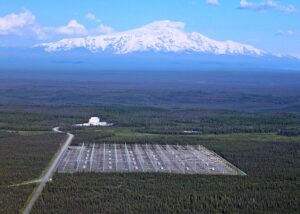
The High Frequency Active Auroral Research Program (HAARP) is an ionospheric research program jointly funded by the U.S. Air Force, the U.S. Navy, the University of Alaska, and the Defense Advanced Research Projects Agency (DARPA). Designed and built by BAE Advanced Technologies (BAEAT), its purpose is to analyze the ionosphere and investigate the potential for developing ionospheric enhancement technology for radio communications and surveillance. The HAARP program operates a major sub-arctic facility, named the HAARP Research Station, on an Air Force–owned site near Gakona, Alaska.
HAARP has been the topic of conspiracy theories for quite some time, which range from HAARP being capable of modifying weather, disabling satellites and exerting mind control over people, and that it was being used as a weapon against terrorists. Such theories blamed the program for causing earthquakes, droughts, storms and floods, diseases such as Gulf War Syndrome and Chronic Fatigue Syndrome, the 1996 crash of TWA Flight 800, and the 2003 destruction of the space shuttle Columbia.
Below are documents obtained about HAARP, and are archived here for research and are listed in chronological order of report date.
Environmental Impact Study
 Environmental Impact Statement. Volume 1. Proposed High Frequency Active Auroral Research Program, July 1993 [
450 Pages, 21MB ] – The FEIS describes the potential environmental
impacts of constructing and operating a proposed ionospheric research
facility in interior Alaska. The system is referred to as
HAARP(High-frequency Active Auroral Research Program), and would be used
primarily for conducting pioneering studies of ionospheric properties.
This proposed facility would be the most technologically advanced in the
world. The program could lead to a better understanding of the
ionosphere and enable researchers to develop methods for enhanced
communications for both civilian and defense applications. The HAARP
system consists of a powerful high frequency radio transmitter, referred
to as the ionospheric research instrument, and a number of scientific
data gathering (diagnostic) instruments. This document addresses three
alternatives associated with the construction of the HAARP facility;
namely construction at either Clear or Gakona, and the no action
alternative. Issues and resources that were examined for both of the
sites include land and minerals, vegetation and wetlands, mammals,
birds, aquatics, hydrology and water quality, air quality,
socioeconomics, cultural resources, subsistence, recreation, aesthetics,
possible bioeffects of radio frequency radiation, electromagnetic
environment and radio frequency interference, atmosphere, threatened and
endangered species, hazardous materials and wastes, and irretrievable
commitment of resources.
Environmental Impact Statement. Volume 1. Proposed High Frequency Active Auroral Research Program, July 1993 [
450 Pages, 21MB ] – The FEIS describes the potential environmental
impacts of constructing and operating a proposed ionospheric research
facility in interior Alaska. The system is referred to as
HAARP(High-frequency Active Auroral Research Program), and would be used
primarily for conducting pioneering studies of ionospheric properties.
This proposed facility would be the most technologically advanced in the
world. The program could lead to a better understanding of the
ionosphere and enable researchers to develop methods for enhanced
communications for both civilian and defense applications. The HAARP
system consists of a powerful high frequency radio transmitter, referred
to as the ionospheric research instrument, and a number of scientific
data gathering (diagnostic) instruments. This document addresses three
alternatives associated with the construction of the HAARP facility;
namely construction at either Clear or Gakona, and the no action
alternative. Issues and resources that were examined for both of the
sites include land and minerals, vegetation and wetlands, mammals,
birds, aquatics, hydrology and water quality, air quality,
socioeconomics, cultural resources, subsistence, recreation, aesthetics,
possible bioeffects of radio frequency radiation, electromagnetic
environment and radio frequency interference, atmosphere, threatened and
endangered species, hazardous materials and wastes, and irretrievable
commitment of resources.
Environmental
Impact Analysis Process. Final Environmental Impact Statement. Part 2.
Proposed High Frequency Active Auroral Research Program [ 410 Pages, 21MB ]
Research Documents
HAARP, Research and Applications, 1990 [
19 Pages, 1.25MB ] – This report describes and documents the scientific
uses and the wide range of applications created by the HF Active
Auroral Research Program (HAARP). The report is based on the
deliberations of a scientific committee sponsored by the Air Force
Research Laboratory and the Office of Naval Research and convened by the
East-West Space Science Center of the University of Maryland. The HAARP
represents a technological advancement with capabilities that allow for
new and unique dual-use research and application opportunities. Use of
the ionosphere as an active, nonlinear medium allows the primary HF
energy to be transformed in a controlled fashion into coherent radiation
from 0.001 Hz to 40 kHz and into incoherent IR and visible wavelengths.
This function, supplemented with the generation of FAS and with the use
of the transmitter as a radar, makes the HAARP transmitter a unique
source for remote sensing and communication uses.
Electromagnetic
Interference Impact of the Proposed Emitters for the High Frequency
Active Auroral Research Program (HAARP) 14 May 1993 [ 134 Pages,
4.9MB ] – The proposed HAARP emitters at the Gakona (Alaska) preferred
site and at the Clear AFS (Alaska) alternative site are the Ionospheric
Research Instrument (IRI), the Incoherent Scatter Radar (ISR), and the
Vertical Incidence Sounder(VIS). The electromagnetic interference (EMI)
impact of those emitters on receiving systems in the vicinity of the
sites is estimated in this study. The results are intended for use as an
input to the Air Force Environmental Impact Statement as part of the
Environmental Impact Analysis Process.
An
Electromagnetic Interference Study of Potential Transmitter Sites for
the HF Active Auroral Research Program (HAARP), 19 July 1993 [ 40
Pages, 1.81MB ] – This report presents the results of Electromagnetic
Interference (EMI) measurements conducted by the Naval Research
Laboratory in June of 1991. This study examined a number of potential
sites for the location of the proposed High Frequency Active Auroral
Research Program (HAARP) transmitter facility. The proposed HAARP
facility will consist of a large planar array of antennas excited by
phased high power transmitters operating in the lower portion of the HF
band (2.8 to 8 MHz). Several candidate locations were identified for
study in the vicinity of Fairbanks, Alaska. The magnitude of EMI in the
population centers and on other commercial and public facilities in the
vicinity of Fairbanks from the high power transmitter is a major factor
in the site selection process for HAARP. The EMI investigations were
conducted in two phases. For Phase I of the study, EMI measurements were
conducted at two receiver locations using an airborne transmitter at
thirteen potential HAARP sites. The results from the Phase I
measurements were examined and the two most promising candidate
transmitter locations were selected for more comprehensive measurements
during Phase II. For Phase II, comprehensive EMI measurements were made
for each of the two candidate transmitter sites. Field strengths were
measured at a variety of receiver locations that are representative of
the impact area for the EMI from HAARP. The results for both the Phase I
and Phase II measurements are presented in this report.
High Frequency Active Auroral Research Program (HAARP) Imager, 30 September 1993 [
322 Pages, 10.2MB ] – A low-light-level monochromatic imaging system
was designed and fabricated which was optimized to detect and record
optical emissions associated with high-power rf heating of the
ionosphere. The instrument is capable of detecting very low intensities,
of the order of 1 Rayleigh, from typical ionospheric atomic and
molecular emissions. This is achieved through co-adding of ON images
during heater pulses and subtraction of OFF (background) images between
pulses. Images can be displayed and analyzed in real time and stored in
optical disc for later analysis. Full image processing software is
provided which was customized for this application and uses menu or
mouse user interaction.
HAARP High Power Experiments and Observations of Ionospheric Interactions, 1996 [
5 Pages, 0.2MB ] – We review experiments in ionospheric modification
and long distance propagation performed at the HAARP facility. Most
experiments were in bistatic configuration with the WAVES receiver on
the NASA/WIND satellite. Initial experiments showed scintillation-like
variations in low frequency propagation through the earth’s ionosphere. A
HAARP-HIPAS transmission experiment set up a spatial interference
pattern measured at WIND. The Kodiak SuperDARN radar scanned the
modified region above HAARP and observed the growth of ionospheric
irregularities. Recently, lunar echoes at 8 MHz were detected by WIND.
The experiments at HAARP will extend to nonlinear regimes as power
levels increase.
Imaging of Underground Structure Using HAARP, February 1999 [
48 Pages, 3.3MB ] – Non-invasive imaging of underground structure is
important for the detection of hidden tunnels and other hazards, as well
as resource exploration, mineral exploration, and environmental
contamination problems. We processed and analyzed electromagnetic
imaging data sets provided by the Air Force Research Laboratory (AFRL).
The main parts of this study included: 1) subsurface imaging using
smooth minimum-structure algorithms, 2) adaptation of imaging algorithms
for parametric inversions, 3) analysis of the sensitivity and
resolution of data to subsurface features and sharp boundaries, and 4)
modification of robust processing algorithms for AMT data. Our analysis
using synthetic data for simple models indicates the subsurface tunnels
can be successfully detected if they are at a depth to diameter ratio of
approximately 3:1 or less. Detection of tunnels in actual field
conditions is more difficult because of the low signal levels in the AMT
frequency range and geologic noise. This was evident in all data sets
analyzed under this contract. The HAARP transmitter has the potential to
be a valuable exploration tool in that it could generate EM fields that
appeared locally as plane waves and could overcome the problems with
low AMT signal levels and geologic noise. Our modifications to robust
processing algorithms for AMT data and for controlled source data have
proven useful for analyzing data with low signal levels and large
amounts of noise.
Geophysical Electromagnetic Sounding Using HAARP, March 2002 [
14 Pages, 1MB ] – The electrical resistivity of the ground can be
measured by several methods. One, which has proven useful, is the
controlled source magnetotelluric method (CSAMT). Current over a wide
range of frequencies is introduced into the earth through a grounded
dipole. Then the resulting electric and magnetic fields are measured at a
distance greater than several skin depths. The apparent resistivity is
then calculated by: p = 1/5f E/B(exp 2) The apparent resistivity vs.
frequency can be converted into true resistivity vs. depth, This grant
involved an investigation into the HAARP virtual antenna pattern out to
200 km, and its use as a CSAMT transmitter.
High Frequency Radar Astronomy With HAARP, 2003 [
7 Pages, 0.4MB ] – At high frequency, radio waves will interact with
space plasmas and surfaces of local astronomical objects, producing an
echo that can provide new diagnostic data. The availability of high
power radars operating at high frequencies opens a window for the remote
investigation of our surrounding space environment. We discuss and
illustrate this technique with some specific examples.
Investigation
of Plasma Phenomena in the Ionosphere Under Natural Conditions and
Under Conditions Artificially Perturbed by HAARP, 17 August 2005 [
81 Pages, 50.2MB ] – Under this contract, Northwest Research Associates
(NWRA) is performing measurements of the ionosphere in order to
investigate plasma phenomena in both the natural ionosphere and in the
ionosphere perturbed by the High-frequency Active Auroral Research
Program (HAARP) high-frequency heater. The research being conducted
falls within Hanscom Technical Areas 3(a), “Ionospheric Effects Research
and Department of Defense Systems,” and 3(b), “Ionospheric Research
Technology,” of the Broad Agency Announcement VS-O3-Ol released by the
Air Force Research Laboratory (AFRL). As a contribution to Technical
Area 3(b), we are collaborating with scientists and engineers from AFRL,
the Naval Research Laboratory (NRL), and other research organizations
in the application of diagnostic instrumentation to HAARP. Among the
HAARP instruments that we are applying to ionospheric research are three
NWRA ITS1OS coherent radio receiving systems for measuring relative
Total Electron Content (TEC) and recording scintillation, and an Ashtech
Model Z-FX UPS receiver for measuring absolute TEC. We are posting TEC
from these instruments, and phase-scintillation records from the ITS10S
receivers, on the HAARP Web site (www.haarp.alaska.edu) for telescience
applications and for decision-making during active experiments, and we
are also focusing on inverting the TEC data tomographically to produce
images of the F layer over Alaska. Research topics under the foregoing
objectives are reported in Section 2.
Report on the HAARP 2008 Winter Campaign Focusing on Artificial Ionospheric Irregularities, 31 July 2008 [
110 Pages, 14.1MB ] – A research campaign was conducted at the joint US
joint Air Force, US Navy, and DARPA High-Latitude Active Auroral
Research Program (HAARP) site near Gakona, AK, during the period 21
February through 3 March 2008. The focus of the campaign was on
generation of plasma-density irregularities in the ionosphere an optical
and RF emissions from the ionosphere as a by-product of the interaction
between the HAARP HF heater and the atmosphere and ionosphere above
HAARP. This report documents the preliminary results obtained from this
campaign through short (two to three page) summaries provided by the
Principal Investigators for each of the experiments runs.
Jhon Greenewald
No comments:
Post a Comment
Note: Only a member of this blog may post a comment.