Statistiche

Thursday, August 5, 2021


Misterio por la aparición de siete vacas mutiladas en Santa Fe ( infobae )
:quality(85)//s3.amazonaws.com/arc-wordpress-client-uploads/infobae-wp/wp-content/uploads/2018/08/06044441/Chupacabras.jpg)
Los productores de Colonia Durán, al norte de Santa Fe, no encuentran una explicación definitiva. Nuevamente aparecieron animales muertos en el medio del campo con extrañas mutilaciones.
Algunos hablan de luces extrañas en el cielo que "no son estrellas", otros lo relacionan directamente con el "chupacabras", un mítico ser que según la cultura popular ataca a distintos animales.
Norberto Bieri, dueño de las siete vacas preñadas que aparecieron mutiladas, relató al medio local Reconquista que "a las vacas les falta la lengua y las quijadas" pero "no (se) llevan a los animales, ni un solo hueso".Y agrega sorprendido: "Es como que harían (sic) los cortes con un láser, no hay rastro de cuchillo. Los animales no tienen sangre y nadie los come, ni las aves carroñeras".
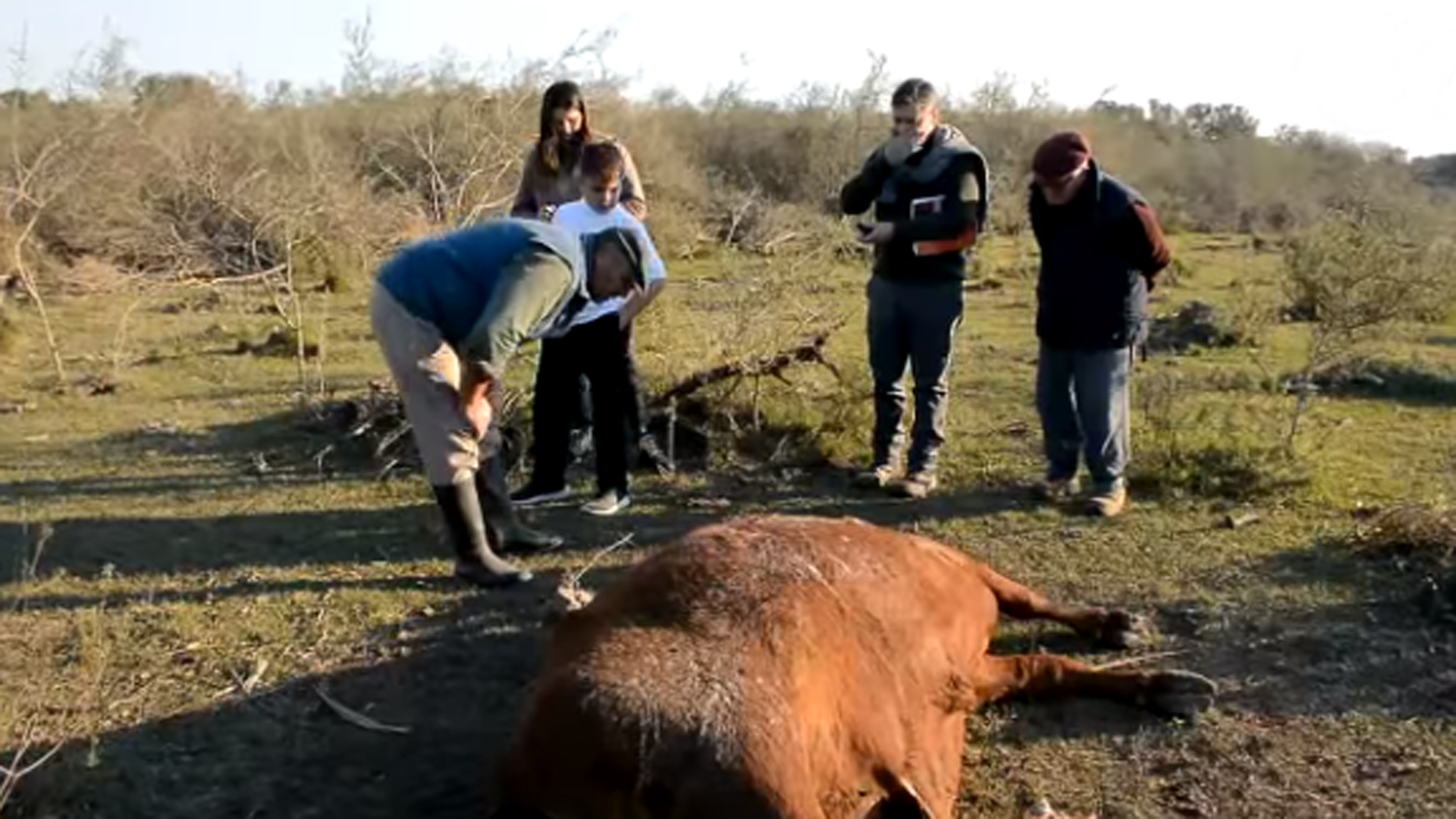
Los productores también aseguran que los veterinarios mandaron muestras para analizar en un laboratorio pero no obtuvieron resultados concluyentes. No hubo envenenamiento ni shock eléctrico.
"Unos dicen que es el chupacabras o extraterrestres, otro dicen que son ratones, pero lo cierto es que los animales están muertos, en concreto no hay nada", resume Bieri. Aseguran que hubo varios casos más en la provincia.
Lasers Destined For Fighter Jets Are Now Being Tested In The Air Force’s Wind Tunnels ( The War Zone )

Wind tunnels are being used to help accelerate the Air Force’s delayed airborne laser ambitions.
Ahead of putting experimental directed energy weapons onto its fighter jets, the U.S. Air Force is testing how these systems will operate at high speed and high altitude, by trialing them in wind tunnels. Equipping fighters with directed energy, or DE, weapons, which use high-energy lasers or microwaves to engage threats, is a long-standing Air Force ambition, but one that has suffered from some well-documented delays. The latest wind tunnel work may help address some of the problems encountered so far.
The Air Force has announced that recent DE systems tests have taken place in the four-foot transonic wind tunnel, or 4T, belonging to the Aerodynamics Branch of Arnold Engineering Development Complex (AEDC) at Arnold Air Force Base, Tennessee. By experimenting with a DE system in a wind tunnel of this type, it’s possible to assess how the weapon behaves when it encounters shockwaves left by the aircraft carrying it, as well as other disturbances that might affect the weapon’s energy beam and prevent it from engaging the target properly.

Dr. Rich Roberts, chief of the Aerodynamics Branch Store Separation Section of Arnold Engineering Development Complex, looks at a directed energy (DE) system turret in the four-foot transonic wind tunnel at Arnold Air Force Base, Tennessee, in March.
Using the 4T, engineers should be able to explore what happens to a DE weapon in the airflow when the host aircraft is operating at speeds of up to Mach 2.0, as well as at simulated altitudes ranging from sea level up to 98,000 feet. It’s unclear what parameters have been tested so far, but the Air Force has confirmed that the 4T has already been used to simulate a laser-toting fighter jet flying at supersonic speeds.
“Integrating the DE systems on aircraft has obvious benefits but also creates challenges, especially at higher speeds,” admitted Dr. Rich Roberts, chief of the Aerodynamics Branch Store Separation Section at Arnold Air Force Base.
Nevertheless, with the Air Force still hopeful of migrating DE systems onto high-performance fighters in the not-too-distant future, the service is hoping to iron out problems in the wind tunnel before integrating these systems onto actual aircraft.
The effort so far has taken around eight years, according to the Air Force, and has focused on the Aero Isolation Measurement System, or AIMS, which allows this kind of DE testing in wind tunnels.

Close-up of a DE system turret in the 4T wind tunnel at Arnold Air Force Base, with a simulated laser glow.
“Simply put, this system transmits a laser to the model, uses a miniaturized optical bench of sorts inside the model, then uses fiber optics to pipe the data to a wavefront sensor system,” Roberts explained. “From there, we can analyze data that tells us how the laser was impacted by the tunnel flow field around the model.”
In particular, the Defense Advanced Research Projects Agency (DARPA) is keen to reduce the impact of high-speed flow over a turret armed with a DE weapon, in what is described as “flow mitigation.”

Computational fluid dynamics simulations for a DE pod, showing pressure
loading on the pod and airflow features under supersonic conditions.
So far, the Air Force has developed an “aerodynamic fence” that protects the DE system from the turbulent airflow over the turret that contains it. The result was, according to Roberts, “a significant improvement in beam quality.”
Beyond the AIMS equipment, the AEDC is working on the Integrated Directed Energy Aero-Optical Surrogate, or IDEAS, which will provide a 1:4-scale model of an F-15 fighter that will be used to test laser pods in a wind tunnel. Acceptance testing for IDEAS hardware is due to begin later this year.

Two images from high-speed wavefront tests of the DE pod, showing a
shock over the pod aperture (left) and computational fluid
dynamics-predicted optical distortion formed over the aperture for
similar flow conditions (right).
While this all furthers the ambition of Air Force fighters mounting DE pods capable of defending them against incoming missiles, it should be recalled that, not so long ago, it was anticipated that a full-scale F-15 would be flying with a demonstrator weapon of this type in 2021. That pod was the Self-Protect High Energy Laser Demonstrator program, or SHiELD, which has now been delayed by two years, with flight testing aboard an F-15 now planned for 2023.
Part of the reason for this delay was the impact of the COVID-19 pandemic, but there were also technical challenges that proved hard to overcome in the original timescale, not least of which includes fitting the laser and the beam control equipment into a single, fairly small pod. On top of that, while deploying an effective laser may be a challenge to overcome in still air, using adaptive optics, at high speed in a fighter, it is even more difficult. The pods themselves also have to be robust, able to withstand constant buffeting and heavy G loads, without damage to any sensitive internal equipment.

Members of the SHiELD program and a Boeing contractor team inspect a SHiELD pod, earlier this year.
A year ago, the influential Will Roper, then the Assistant Secretary of the Air Force for Acquisition, Technology, and Logistics, stated that he envisaged lasers might be best used to counter small unmanned aerial vehicles. He pointed to the high costs of using missiles against potentially low-cost drones and suggested that high-end fighter jets might not be the most obvious candidate to field DE weapons, at least at first.
Meanwhile, there has been some progress made by using a ground-based solid-state laser known as the Demonstrator Laser Weapon System (DLWS) as a surrogate for SHiELD. In this way, DLWS has proved its ability to shoot down a number of air-launched missiles over the White Sands Missile Range in News Mexico. Although ground-based laser systems are generally more mature than their airborne counterparts, it’s worth noting that the DLWS is described as being in the “tens of kilowatts class,” while Lockheed Martin has already delivered a 60-kilowatt-class laser weapon system to the U.S. Army.

The Demonstrator Laser Weapon System (DLWS), acting as a ground-based test surrogate for the SHiELD system.
Separate, earlier efforts to develop airborne podded laser weapons seem to have made greater strides, however, with the Army having flight-tested a podded solid-state laser on an AH-64 Apache attack helicopter in 2017. Back in 2014, the Air Force Research Laboratory (AFRL), together with the Defense Advanced Research Projects Agency (DARPA) and Lockheed Martin, also tested a turreted laser on a modified Dassault Falcon 10 business jet as part of the Aero-Adaptive, Aero-Optic Beam Control (ABC) program.
Outside of smaller podded systems intended to provide defense against incoming missiles, like SHiELD, there have also been difficulties in maturing the laser technology required for the Missile Defense Agency (MDA) to shoot down ballistic missiles during the initial boost phase of flight, too.
Last year, Michael D. Griffin, the then Under Secretary of Defense for Research and Engineering, questioned whether putting a directed energy weapon of this type onto a drone would actually result in a platform able to shoot down or disable enemy ballistic missiles as originally intended.
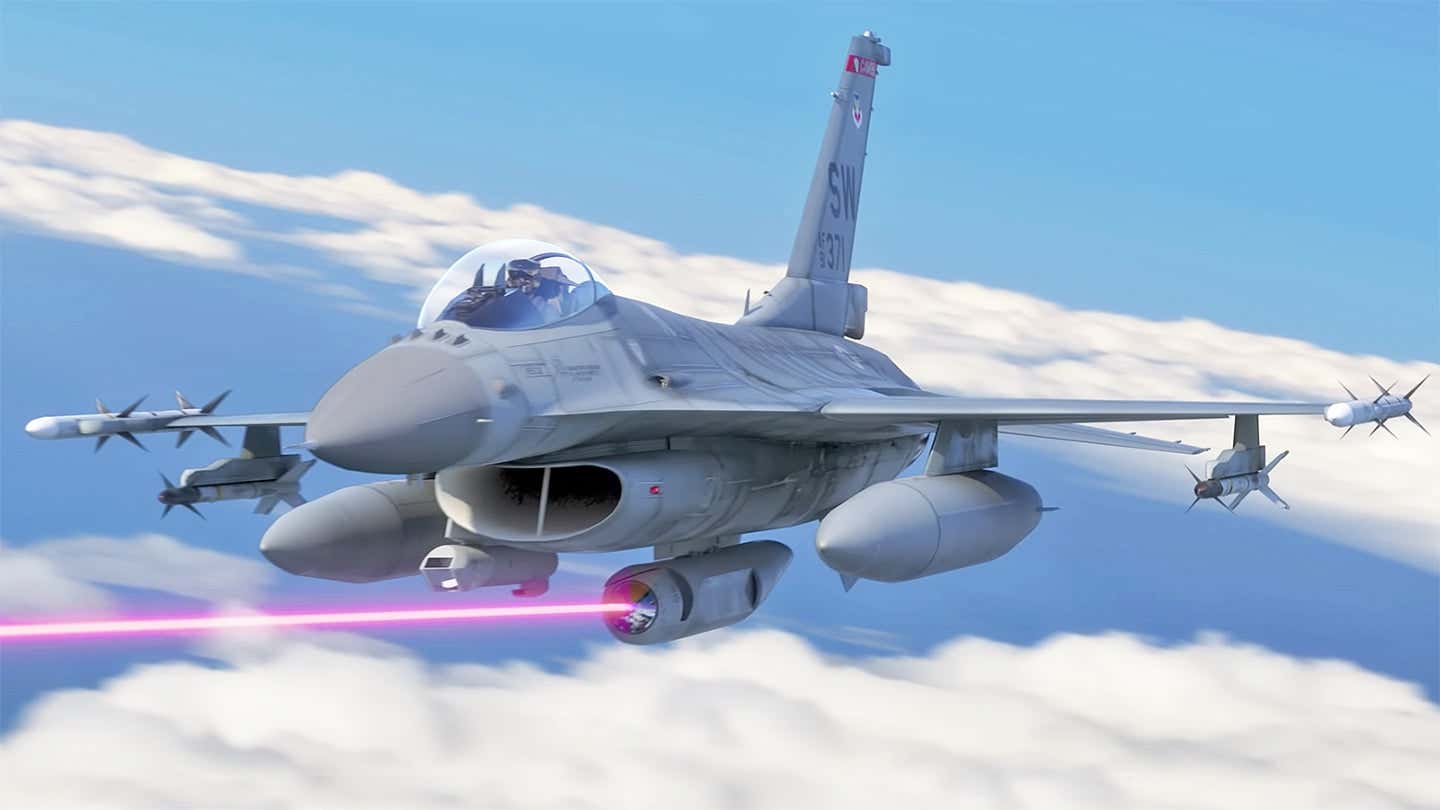
An artist’s rendering of an Air Force F-16 armed with a SHiELD pod.
With both the SHiELD pod and the MDA’s efforts to develop an airborne missile defense laser apparently faltering, the last few months have not been particularly positive for these types of DE weapons.
Dr. Rich Roberts is optimistic that work at Arnold Air Force Base could benefit plenty more programs, too.
“As more DE systems are developed and integrated onto aircraft, we’ll be able to help with design decisions, creating employment envelopes, defining adjacent weapons load-outs and other things routinely needed by program offices and manufacturers,” Roberts said.
Hopefully, this wind tunnel testing helps the SHiELD pod move towards the live flight test phase. But the new ability to perform initial tests of these kinds of weapons in wind tunnels could provide a significant boost to a whole range of airborne directed energy programs.
Thomas Newdick
Tuesday, August 3, 2021
UFO believers launch support group dubbed 'Aliens Anonymous' to bond over sightings ( DailyStar )

Up to 50 people regularly gather at the meetings at a pub in Todmorden, West Yorkshire where they try to "come to terms" with their spooky UFO and alien experiences
Alien hunters have launched their own AA-style group some have dubbed “Aliens Anonymous” to help cope with their sightings.
Up to 50 UFO obsessives regularly gather to discuss extra-terrestrial experiences in the town of Todmorden in West Yorkshire.
They meet up in a pub where they try and come to terms with their close encounters.
Among them are artist James Fearon, 61, who came up with the name Aliens Anonymous after he finally found people who believed him following years of mockery.
He claims he was abducted by ETs three decades ago in Portadown, Northern Ireland - even though he admits he was “a bit drunk at the time”.
James said the “impish” aliens were under the command of a larger female figure with “reassuring eyes” and they put him on an operating table before doing unpleasant things.
But he says telling others in the past had been a mistake, adding: “I said, ‘You’ll never guess what happened to me last night.’
“When I told him, my friend replied, “F*** off, Fearon.’
“It felt very real to me, but I didn’t speak about it again until I came to these meetings.”
Others from the group - also known as Todmorden UFO Meet - say recent US military reports saying UFOs were “of concern” were a “comfort” that may make disbelievers think again.
And despite sometimes taking stick from punters at the bar, the group enjoys swapping their stories.
Leader Colin Lyall - known to locals as UFO Man - claims he saw a silver ball zoom across the sky before disappearing behind a cloud at a protest against public-sector cuts in Manchester a few years ago.
Meanwhile one of Colin’s theories is that the visitors could be young aliens visiting Earth during their gap years.
He said: “The Americans have helped to stir the public debate and that’s good.
“It will help us to find out more about what they are. If they’re tourists or alien kids coming to Earth for a laugh on their gap year, I don’t know.
“Nobody has the answer.”
Patty’s Triangle Remains Among Michigan’s Most Baffling UFO Sightings ( HOUR )
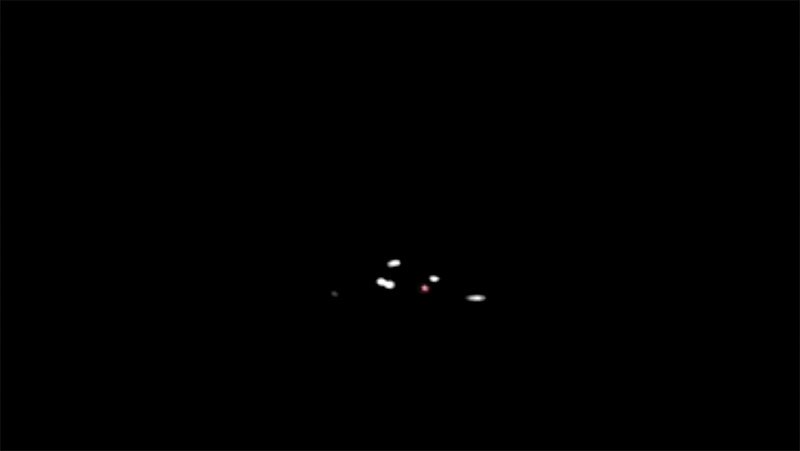
Photograph courtesy of Michigan Chapter of the Mutual UFO Network
What am I looking at?
Nobody really knows. Unofficially, it’s called Patty’s Triangle because a woman named Patty Blackburn caught it on camera on June 14, 2006, near Lansing. In 24 seconds of video, Patty captured an unexplainable triangular configuration of lights that jerked around the sky. Maybe it’s a military aircraft that nobody’s seen before, or maybe it’s extraterrestrial beings from galaxies far, far away accidentally giving Earthlings a glimpse of themselves while surveilling humankind. Those, it seems, are the two most likely options to longtime aficionados of unidentified flying objects or, as the U.S. government has rebranded them, “unidentified aerial phenomena.”
Why are you showing me this particular blur?
Mostly because, as obscured and fuzzy as it is, it’s the best available image of a UFO from a Michigan sighting. Hundreds of sightings are reported each year to the Michigan chapter of the Mutual UFO Network (MUFON), but the vast majority are resolved as something of clearly human origin. Patty’s Triangle is among the few that remain unexplained, says Michigan MUFON State Director Bill Konkolesky.
OK, but why should I care about something someone saw 15 years ago?
Because UFOs, once relegated to the province of crackpots, are having a big moment. The federal government, partly prompted by videos shot by U.S. Navy sailors of airborne objects moving in erratic manners that defy the understandings of modern physics, even released a report in June from the Defense Department’s Unidentified Aerial Phenomena Task Force that can be summed up thus: That is, no evidence that E.T. is phoning home but no earthly ideas, either. Of 144 sightings involving military aviators, the task force was able to explain just one — it was a deflating balloon. The other 143 remain a mystery. The feds have been taking the matter seriously for more than a decade now. Then-Sen. Harry Reid, a Nevada Democrat, secured $22 million for UFO research in 2007, and more recently Sen. Marco Rubio, a Florida Republican, told 60 Minutes this spring that he wants answers, too. Last year, former CIA Director John Brennan told a podcaster these incidents “could involve some type of activity that some might say constitutes a different form of life.” And former President Barack Obama sent speculation into hyperdrive by telling TV’s James Corden recently there are “objects in the skies that we don’t know exactly what they are.”
Whoa! Obama believes in little green men?
Not exactly. You don’t have to think a slow-moving alien invasion is underway to accept that there’s weird stuff in the air that defies explanation. But many avid ufologists — yep, that’s a legit word — reason that astronomers claim there are possibly millions of inhabitable planets and moons in the Milky Way or other galaxies. “If life happened somewhere else and they’re even just a couple hundred years more advanced than we are, they probably have the ability to visit us,” says Konkolesky, who notes MUFON officially has no position on the existence of extraterrestrial sentient life. Either way, Konkolesky says interest from credible leaders makes the topic “a lot easier to talk about now. Some neighbors and family members who used to treat it with a giggle now ask with sincere interest. It takes a very short time, when you’re a dedicated, sincere UFO investigator, to conclude something really unusual and unexplainable is happening.”
What’s this Konkolesky guy’s deal, anyway?
He’s a 50-year-old father of two who works in the Academic Support Center at Oakland Community College and found a kinship when he discovered MUFON. He’s also a Michigan native who says that as a high school senior in February 1989, he and some buddies saw a blue football-shaped, car-sized ball of light the height of two telephone poles arching over their Chevette. Then it morphed into a display of white lights that “ping-ponged all over the sky,” followed by a red ball of light the size of a full moon. “We all saw the same thing,” he says. “It took a few years for me to find a group that actually investigates such things.”
Are there lots of UFO sightings in Michigan?
Michigan’s MUFON chapter received 2,789 sightings from 2010 to 2020, of which 80 to 95 percent turned out to have easy, earthly explanations, Konkolesky says. In 2019, for instance, a third of the reports turned out to be sightings of SpaceX’s Starlink satellites, a stream of thousands of machines floating in a line in low-Earth orbit that aims to provide low-cost internet access the world over. There are four still-unexplained sightings that stand out — a 1953 sighting of disc-shaped objects darting across Lake Superior over the Soo Locks; a cluster of sightings in 1966 in which “many hundreds of witnesses” saw UFOs across southeastern Michigan, capped by a claim by a Dexter man of a landing in his backyard; a 1975 incident in which people at four Air Force bases where nuclear weapons were stored around the U.S., including Wurtsmith in Iosco County, saw a white disc descend for a bit before flitting off; and a 1994 sighting outside Grand Rapids that prompted a flood of calls to 911 and front-page coverage in the Detroit newspapers.
What do I do if I see something?
You can call the police, the military, or your shrink, as many people do. Or you can contact Konkolesky via mufon.com. Be aware, though, that Konkolesky offers this caveat: “If they’re saying something landed in their backyard, there’s not a lot we can do for them.”
Steve Friess
UFO Hunting, With Harvard Data: Astrophysicist Advocates For Scientific Investigation ( GBH )

The search for life beyond Earth has long inspired all and some — and eyerolls in others. But in recent years, new reporting has made it clear that there really have been hard-to-explain encounters between humans and something that may be operating technology that seems straight out of science fiction. One scientist who's taking the search seriously is Harvard astrophysicist Avi Loeb, who joined GBH’s All Things Considered Friday. He's the leader of the new Galileo Project, which will be looking into space for possible evidence of extraterrestrial civilization. What follows is a lightly edited transcript.
Arun Rath: So, tell us, what inspired you to launch the Galileo Project?
Avi Loeb: Two things. In 2017, there was an object — the first one that was identified from outside the solar system that arrived close to Earth — and it didn't look like anything we've seen before. It didn't look like a comet, it didn't behave like an asteroid.
Rath: The subject of our last conversation.
Loeb: Yes. And I thought maybe it's artificial in origin. And, in fact, I wrote a book about it, Extraterrestrial, that was published six months ago. And then a month ago, there was a report delivered to Congress saying: there are things in the sky above the U.S. whose nature is not identified. And you would think that's a serious matter, because the intelligence agencies are admitting that they are not doing their job. Their job is to protect us from adversaries, to identify anything that flies in our sky. And here they come to Congress and say, 'There are some objects that we believe are real, but we don't understand their nature. They do not behave in ways consistent with the technologies that humans develop.'
And so here I come and say, 'Great, well, that's a fascinating subject, very intriguing. Let's try and figure it out as scientists.' And in fact, the NASA administrator, Bill Nelson, said the same thing around that time. So I approached people under him, and I said, 'Here I am to serve and make your boss happy.' Nobody got back to me. And then a week later, I was approached by a few wealthy individuals that I've never met before who said, 'Here is, in total, 1.75 million dollars, no strings attached. Go ahead and do what you think is right.' And I said, OK, well, that's a great opportunity to assemble a team of exceptional scientists that will try to collect new data.
So in a way, I'm behaving like a kid, because when you come to a kid and say: 'This is the truth,' the kid says, 'I don't believe you, I will go out and check it out.' And that's pretty much the nature of scientific inquiry. We maintain our childhood curiosity. We will build our own telescopes, monitor the sky — the sky's not classified — and we will try to uncover the nature of these weird objects.
Rath: I would think, given the way you describe that, with the release of this report that we're talking about, I would think scientists universally would be very excited — because isn't there a love for mystery in terms of being able to explain extraordinary data? What was the reaction of it in general of the scientific community, or was there much of a reaction to it, beyond you?
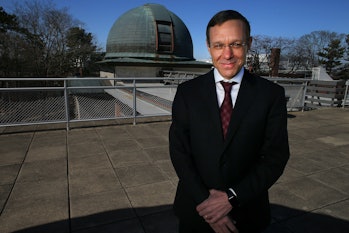
Avi Loeb
Loeb: Well, it was exactly the opposite of what you or I would expect. And the only reason the two of us are speaking is because for some reason, other people are not using common sense. I don't understand it, frankly. You know, I'm pretty much curious about the world — I don't care how many likes I have on Twitter — and I keep my eyes on the ball, not on the audience. But there are lots of people that care how many likes they have on Twitter that try to look smart, to pretend that they know more than they actually know and shy away from topics that might be viewed as controversial.
There is a stigma on this subject, but I think it's not warranted because the public cares a lot about this and the public funds science. And by engaging in this with scientific instruments, you know, we can attract more funds to support science, we can attract a lot of young people that will get engaged in science. And this is not just a theory. I proved it over the past week. I got funding that they didn't ask for, and I got thousands of emails since the program was announced of people interested in getting engaged and helping — scientifically — the project. So, I rest my case.
Rath: So, this information's been released by the the government now. Is there enough data in there to get to get you started? Where do you go from here?
Loeb: Yeah, so I don't want to look at classified data because that would limit my freedom. I want to get new data that will be open to the public and will be analyzed in a transparent way. And that's what we plan to do. We plan to purchase off-the-shelf telescopes, small telescopes — a network of tens to hundreds of telescopes, depending on how much money we have currently. We have 1.75 million dollars. If we get 10 times more, then we can pretty much get a very exhaustive study of the sky accomplished. And basically we will deploy these telescopes in many locations around Earth. They will be connected to cameras that will feed the data to computers, that will analyze it and identify objects of interest. And then the telescopes will track these objects. And of course, key to all of that is to have computer systems that filter out the data and, in real time, identify objects of interest.
Rath: And you talked about how there seems to be a stigma attached to even talking about this among scientists. Is there any sense that that is changing? I mean, you have received a lot of interest in your book and, now, this project.
Loeb: You know, in the thousand plus interviews that I've had over the past six months, I had an opportunity to speak with many young people. And the conclusion is simple. Let's just do it. Let's forget what the audience is saying. Let's just keep our eyes on the ball and do it. And eventually people would join. The way we make progress in science is by being curious, willing to take risks and regarding it as a learning experience. You know, it's completely allowed for us to be wrong. So if we examine new data on the sky and find a mundane explanation to all these UAP — unidentified aerial phenomena — so be it. We learn something new. There must be some exotic phenomena taking place in our atmosphere. The only way we don't learn something new is if we say: business as usual, let's ignore it and we ridicule anyone that tries to suggest that we should get more evidence.
Rath: The report that the government released on these unidentified aerial phenomena, they didn't entertain the idea that this could be because of extraterrestrial intelligence, but they also didn't give an explanation for what on Earth was going on. It certainly makes a certain kind of common sense that like that unexplainable technology, things flying in the air, you could imagine that being an extraterrestrial civilization, but are there are there other explanations that make sense, or do your scientific colleagues or anyone else offer something that that's plausible — other than alien activity?
Loeb: Well, unfortunately, the data that was released to the public is not of high-enough quality. You know, it was obtained in a jittery camera that was in the cockpit of a fighter jet. And that's not the kind of data you can use for a scientific investigation because you don't have full control over your experimental setup. And in science, you cannot rely on eyewitness testimonies. Of course, in the courtroom, if there is corroborating evidence through eyewitness testimonies, that's enough to put the person in jail. But you cannot write a scientific paper based on what people tell you. That's not good enough.
What you need is instruments that the record quantitative data that you analyze, and that's what we plan to get. Rather than rely on past testimonies or past reports that do not stand up to the scrutiny of modern science, let's just get the data and figure it out. Again, like kids, I was asked by the Harvard Gazette — the Pravda of Harvard University — what is the one thing that I would like to change about my colleagues? And I answered, I would like them to behave more like kids.
Rath: Professor Loeb, it's, again, great speaking with you, and let's check in once you get some data to to talk about.
Loeb: Yeah, you would be the first to know if you find the evidence for A.I. systems from another civilization.
Arun Rath & Matt Baskin
Tutto quello che volevo sapere sugli Ufo e che ho osato chiedere ( Linkiesta )

Il senatore degli Stati Uniti Harry Reid racconta le sue esperienze con i cosiddetti “fenomeni aerei non identificati” e la sua ostinazione nel voler sapere di più riguardo ad alcuni strani avvistamenti. Nel giugno scorso il Pentagono ha fornito alcuni dati in materia, ma rimangono ancora molte le domande senza risposta.
Un giorno del 1996 ho ricevuto una telefonata da George Knapp, che è un reporter investigativo di KLAS-TV, emittente di Las Vegas del network CBS, ed è anche un mio amico. «Harry, c’è una cosa alla quale devi partecipare», mi disse.
E mi invitò a una conferenza, prevista di lì a poco, che avrebbe avuto come argomento quelli che il governo americano definisce abitualmente “fenomeni aerei non identificati” e che la gran parte delle persone chiama semplicemente Ufo: un tema verso cui Knapp nutriva, e tuttora nutre, un interesse particolare.
In occasione dell’evento, una grande sala convegni si riempì di docenti universitari, di persone comuni interessate all’argomento e, sì, di qualche tipo stravagante. Rimasi molto impressionato dai professori, che parlavano di fenomeni aerei non identificati con linguaggio scientifico, discutendo il tema in termini di sviluppo tecnologico e sicurezza nazionale. Ne fui catturato.
Negli anni seguenti, mentre il mio interesse per gli Ufo aumentava – anche grazie alle mie conversazioni con l’ex astronauta John Glenn, un collega in Senato che condivideva le mie curiosità – il mio staff mi raccomandò di non farmi vedere mentre mi occupavo di questo argomento. «Tieniti maledettamente lontano da tutto ciò», mi dicevano. Li ho gentilmente ignorati. Ero curioso. Come il senatore Glenn, ritenevo che quello fosse un tema da indagare ed ero nella posizione per fare qualcosa.
E qualcosa ho fatto.
Nel 2007, mentre ricoprivo il ruolo di leader della maggioranza, ho lavorato con il senatore Ted Stevens, un Repubblicano dell’Alaska, e con Daniel Inouye, un Democratico delle Hawaii, perché fossero stanziati fondi per 22 milioni di dollari per quello che sarebbe diventato noto come Advanced Aerospace Threat Identification Program (Programma avanzato per l’identificazione delle minacce aerospaziali). Questa operazione segreta del Pentagono condusse ricerche sui report riguardanti gli Ufo e altri fenomeni analoghi, compresi gli incontri con gli Ufo che avevano coinvolto personale militare americano. In seguito sono stati resi pubblici alcuni video e alcune fotografie che documentano questi stupefacenti incontri e che hanno ravvivato la fascinazione di lungo corso che l’America ha per gli Ufo.
Benché il programma del Pentagono che ho contribuito a creare non esista più, il governo ha continuato a studiare gli Ufo, da ultimo attraverso un nuovo programma conosciuto come Unidentified Aerial Phenomenon Task Force (Task force per i fenomeni aerei non identificati).
Sono sempre stato affascinato dalle cose che non capisco – da ciò che è misterioso e da ciò che non trova spiegazione – e credo che questa fascinazione derivi in parte dall’essere cresciuto nel Nevada rurale. Vengo da Searchlight, un paese che si trova in pieno deserto, a una cinquantina di miglia a Sud di Las Vegas, e che oggi ha circa 300 abitanti. La casa in cui sono cresciuto era stata costruita con traversine ferroviarie e ho imparato a nuotare nell’unica piscina della cittadina, che si trovava in un bordello. A Searchlight la prostituzione aveva sostituito il settore minerario come principale attività economica e c’erano molte case di dubbia reputazione.
Per fortuna c’era anche il grande, splendido cielo con le meraviglie che contiene. Le persone che vivono nell’America rurale, lontano dall’inquinamento luminoso delle grandi città, di notte possono fissare i loro sguardi in cielo e vedere le meraviglie della Via Lattea e molto altro. Nella mia giovinezza a Searchlight ho passato molte sere sdraiato su un vecchio materasso a fissare il cielo sconfinato e pieno di stelle. Sono state poche le notti in cui non ho visto una stella cadente. Quella distesa scintillante riempiva i miei occhi e scatenava la mia immaginazione.
Il fatto di non avere una formazione scientifica è una cosa che mi ha sempre procurato dispiacere. Nella mia scuola elementare non avevamo un’insegnante di scienze. E quando sono andato alla high school erano disponibili soltanto pochi corsi. Ma, nonostante la mia carenza di conoscenze scientifiche (o forse proprio per questa ragione), sono sempre stato molto curioso. Come mai il sole rimane caldo?, mi domandavo. Come mai non si raffredda alla fine del giorno? Da ragazzo non avrei saputo trovare le risposte, ma non ho mai smesso di porre domande. Come disse una volta Albert Einstein, «la curiosità ha in se stessa la propria ragione di esistere».
Anni dopo, quando sono diventato una figura pubblica, ero ancora curioso come prima. Come senatore Democratico per il Nevada, ho visitato l’Area 51, la base sperimentale top secret dell’Air Force che si trova nel Nevada meridionale e che era da lungo tempo associata alle teorie del complotto connesse con gli Ufo. Quello che ho visto mi ha affascinato, benché molte di quelle cose debbano restare coperte da segreto. Durante una di queste visite ho percorso la breve distanza verso la struttura che ospitava i nuovi aerei stealth dell’Air Force, ancora segreti. Per ragioni di sicurezza i piloti potevano farli volare soltanto di notte – sotto quelle stesse stelle del Nevada su cui fissavo i miei occhi quando ero un ragazzo.
Benché l’Area 51 sia stata sviluppata decine di anni fa, all’apice della Guerra fredda, la sua esistenza non è stata pubblicamente riconosciuta dal governo degli Stati Uniti fino al 2013. Farlo prima avrebbe messo a rischio la sicurezza del nostro Paese, dal momento che il governo cerca sempre un equilibrio tra le priorità della segretezza e la trasparenza che è propria di una democrazia.
Fino a tempi recenti, molti piloti militari avevano timore di essere puniti qualora avessero riportato l’avvistamento di fenomeni aerei non identificati. Ma io ritenevo che l’esistenza di un tabù non ufficiale, che impediva una schietta discussione su questi incontri, avrebbe potuto danneggiare la nostra sicurezza nazionale e ostacolare possibili avanzamenti tecnici. E questo è il motivo per il quale nel 2007, insieme con i senatori Stevens e Inouye, ho contribuito a creare quel programma segreto del Pentagono. Volevamo dare un’occhiata da vicino, e in modo scientifico, alle implicazioni tecnologiche connesse con gli incontri con gli Ufo che erano stati riferiti.
Credo che dalle indagini segrete del governo sui fenomeni aerei non identificati siano state scoperte delle informazioni che potrebbero essere rese pubbliche senza mettere a rischio la nostra sicurezza nazionale. Il popolo americano merita di sapere di più (alla fine del giugno scorso il governo di Washington ha in effetti diffuso un rapporto sui “fenomeni aerei non identificati”, ma la maggior parte degli esperti ha ritenuto piuttosto inconcludenti le analisi contenute in questo documento del governo degli Stati Uniti, ndr).
Ma che cosa ho imparato finora dalle inchieste ufficiali sui fenomeni aerei non identificati? La verità, per quanto possa essere deludente, è che ci sono ancora molte cose che non capiamo. Non è chiaro se gli Ufo in cui ci siamo imbattuti possano essere stati costruiti da Paesi stranieri che sono nostri avversari, se la percezione visiva dei nostri piloti durante alcuni di questi incontri fosse in qualche modo falsata o se davvero abbiamo prove credibili di visite da parte di extraterrestri. E potrebbero esserci ulteriori spiegazioni, ancora sconosciute, per alcuni di questi strani avvistamenti.
In ogni caso, quando si studiano gli Ufo, credo che sia di fondamentale importanza partire dalla scienza. Se concentreremo la nostra attenzione su omini verdi e teorie del complotto non andremo lontano. Naturalmente, qualunque cosa ci dovesse dire la scienza, una parte dell’opinione pubblica continuerebbe a credere all’esistenza di Ufo provenienti da altri mondi come a un articolo di fede. Negli ultimi tempi, il dibattito intorno agli Ufo può essere suddiviso così: da un lato, chi crede sinceramente alla scienza, dall’altro chi crede sinceramente negli extraterrestri. Io sto dalla parte della scienza.
Voglio chiarirlo ancora: non ho mai avuto l’intenzione di provare che esista vita oltre la Terra. Ma se la scienza provasse che esiste, per me non ci sarebbe nessun problema. Perché più imparo e più mi rendo conto che ci sono ancora tantissime cose che non conosco.
Harry Reid